
How the world's first video game console came to be
INFORMATION PIECEVIDEO GAME CULTURE
4/1/20266 min read
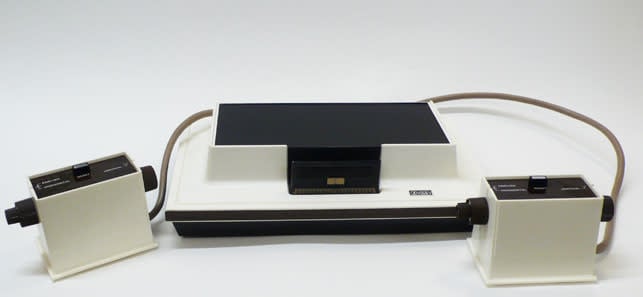
The console gaming market, one of the most lucrative industries in entertainment, is now over 40 years of age. Isn’t that crazy? It’s taken four decades to go from attempting to humanize a few dots on a TV, to mo-capped, fully realized characters in glorious 4K. 40 years, man…. That’s impressive!
But with all of the talk about where we’re heading, what with Nintendo Switch approaching and Microsoft’s revolutionary HoloLens looking sublime, let’s head back into time and have a peek at where console gaming began. Where one man’s humble idea would grow into one of the greatest inventions in technological history.
Magnavox Odyssey: How the first console was born
In 1951, Ralph Baer, the legendary Germany-born inventor and engineer, was working for a company called Loral Electronics, where he would design power line carrier signalling equipment for IBM’s time punch clocks. Later in his employ, he was approached by his bosses to build “the best television set in the world”, which was right up his alley seeing as he had a Bachelor of Science degree in Television Engineering. An accolade that was considered incredibly rare at the time.
Whilst going about designing the TV, an idea dawned on Baer: what if you were able to do more with your gogglebox than just…watch TV broadcasts? What if you could control things on your television set? Maybe even play games on it! Unfortunately at the time the idea wasn’t pursued. The most popular reason being his boss wasn’t too thrilled with the idea.
That was that, until 1966 when Baer was heading up military contractor Sanders Associates Inc.’s Equipment Design Division. Whilst waiting for a colleague at a bus depot in New York City, one sunny August day, the idea came hurtling back towards him with a passion. So he hastily scribbled pages of ideas for his tech, and the next day Baer set to work changing the way we would interact with our pictureboxes forever.
I distinctly recall sitting there on a sunny day and writing on a small spiral note book perched on one knee…those notes have disappeared. Not so the pages of the Disclosure Document that I wrote the following morning
The eureka moment
There were about 40 million TV sets in US homes alone in 1966… The Disclosure Document outlined the different types of games Baer thought applicable for TV play. He believed games such as sports games, board games and action games, amongst others, would become the go-to trend if TV games were to take off. Believe me when I say the sheer potential wasn’t lost on Baer. There were about 40 million TV sets in the US homes alone in 1966, to say nothing of many more millions of TV sets in the rest of the world. They were literally begging to be used for something other than watching commercial television broadcasts. Baer’s game box would cost around $20-$25 and, little did Baer know, it would go on to become an international phenomenon.
“Channel LP”, as the device was designated for a short while (LP stands for let’s play), was designed to send a signal to your TV that the TV could tune into like it was an atypical TV channel, which would lead to the RF cables that our NES’, SNES’ and Genesis’ so desired.
Laying the ground work
The good thing about being the head of your very own large division is having full control of which technician does what; a truth that came to flourish under Baer’s tutelage. Due to the size of the operation at Sanders, Baer had the means to have a technician – Bob Tremblay, to be precise – work on something completely separate to the development of complex military electronic systems, without a hitch.
Come December 1966, the first prototype, named “TV Game #1”, was shown in action to Herbert Campman, the then corporate director of R&D at Sanders, who was impressed but tentative to back the tech. Eventually Baer’s TV Game was greenlighted and put on course for completion, with $2500 worth of labor fees and material costs to back them up. So through ‘67 and '68, the development of Baer’s TV games chugged along thanks to Bill Harrison (the hardware guy) who built prototypes and Bill Rusch (the aesthetics guy) who worked on the design of the console and its games. Naturally, with any fresh and bold new idea, some of the management took a rather aloof stance with TV games, asking Baer if he was still “screwing around with this stuff”. But, in Baer’s own words, when the cash from patents and litigations came rolling in, their “attitude[s] changed rapidly”.
The brown box
Prototypes came flooding in from Baer & Harrison, including one with a game that had two players competing to fill or empty a bucket of water. Sounds a bit 1, 2 Switch, that. There was one game with a light gun shooter and another that had two players shown as dots that literally chased each other across the screen. By the time the fourth prototype came around, the team had managed to have said chasing game, a ping-pong game (thanks to Rusch figuring out how to display three dots on the screen instead of two), a light gun game and a special three-dial controller all ready to go. Unluckily for the team of futurists, it wasn’t until 1969’s seventh prototype that companies decided to consider buying the rights to the console.
Dubbed the “Brown Box” due to its design, Baer began showing his tech to any company who agreed to attend Sanders’ invitation. This included RCA, Sylvania, GE, Motorola and, of course, Magnavox. The companies were all interested in the tech, finding it quaint and niche, though only RCA were willing to put hard cash on the table. But, unfortunately again for the “Brown Box”, the deal fell through after both parties couldn’t agree on price. Soon after the initial meeting, RCA exec Bill Enders left the company for Magnavox and persuaded them to take another look at the console. Which they did. It was second-time lucky for Baer and his team as Magnavox agreed to buy the rights and manufacture the console. And after two years of tough negotiation, both parties signed an agreement in January 1971.
The birth of a legend
After Magnavox got their hands on the rights to the Brown Box, the company made some major adjustments to its exterior, and even tweaked its internals, with help from Baer and Harrison. The console was named "Skill-O-Vision" at first, which is a terrible name if you ask me, but eventually Magnavox decided on “Odyssey”, which makes plenty more sense. In order to increase the RRP of the console, Magnavox released the rifle game separately as Shooting Gallery. They also sold plastic overlays to stick on your TV screen to boost the archaic visuals somewhat and added playing cards and paper money. It worked.
From Baer’s original idea of having an innocuous little box where you could play a few games on your TV for $20, the Odyssey ended up retailing for $99.99 ($587.43 today) and, consequently, single-handedly created the video game market.
The King of Kings
The console managed to sell roughly around 100,000 units in 1972. Despite this, come 1973’s Christmas season, Magnavox contemplated ending the Odyssey's production, but persistent sales led them to reconsider that stance and begin shipping Odysseys to Europe, the Soviet Union, and the UK. By the time the console was discontinued in 1975, it had hit a grand total of 350,000 units sold worldwide, and paved the way for consoles and clones like Fairchild Semiconductor Channel F, Home Pong, and the series of Telstar consoles.
Some years later, Baer, now dubbed the father of video games, would go on to collect the National Medal of Technology in 2006 for “his groundbreaking and pioneering creation, development and commercialization of interactive video games, which spawned related uses, applications, and mega-industries in both the entertainment and education realms.” On December 6th, 2014, Baer passed away at his home a hero and a legend to the entire industry. His Brown Box and TV Game #1 prototypes are currently on display at the Smithsonian Institute’s National Museum of American History, and the Museum of Modern Art (MoMA) has permanently added the Odyssey to its video game collection.
Not too shabby for an idea that took off from a few notes scribbled in New York in August of 1966.
You said it, Ralph. You said it.
[Sources: Ralph Baer.com, Wiki, Pong-Story]